
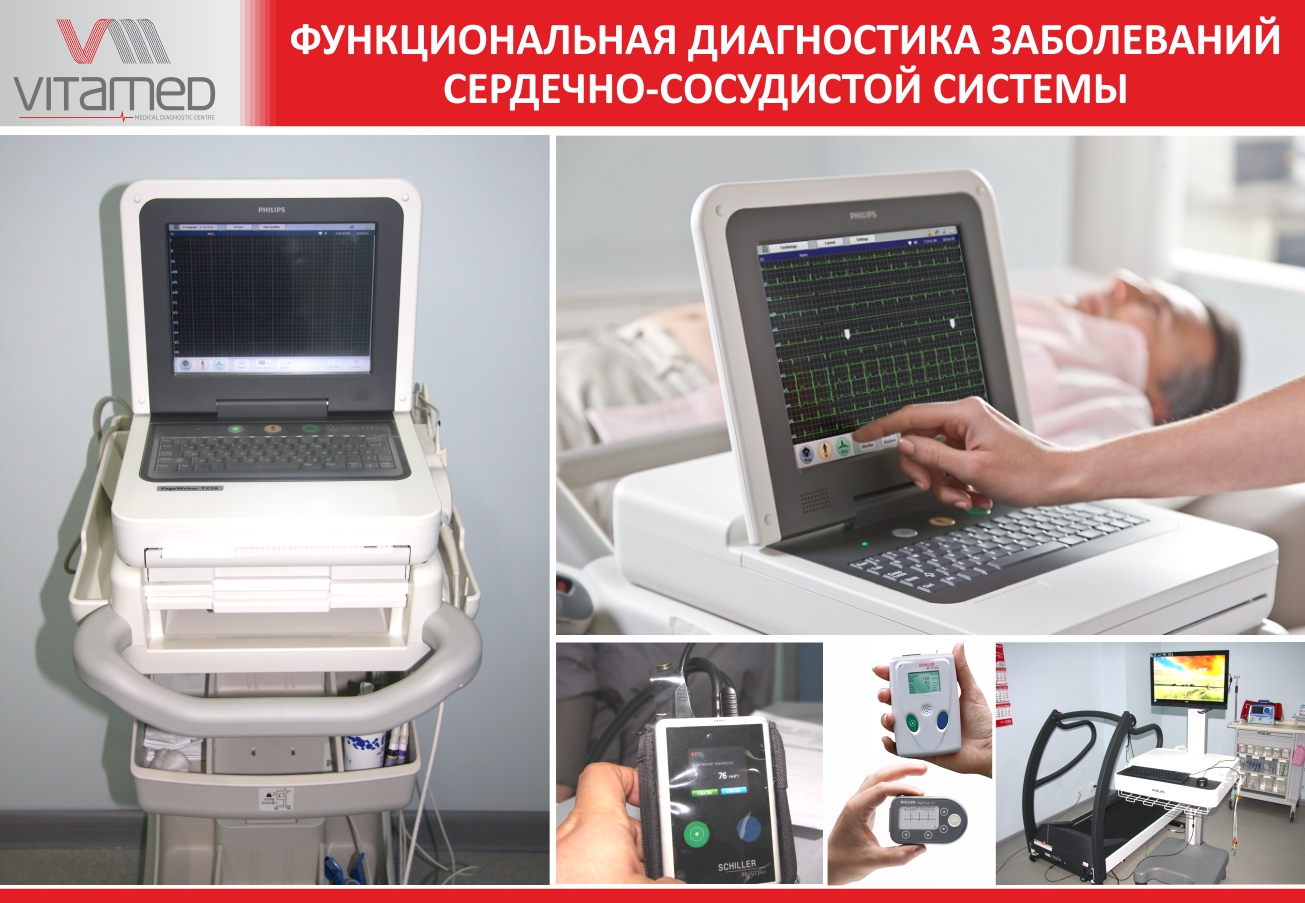
Methods of functional diagnostics of diseases of the cardiovascular system at the Vitamed Medical clinic
1. ELECTROCARDIOGRAM (ECG) is a non-invasive test that provides valuable information about the condition of the heart. The essence of the method is to record the electrical potentials that arise during the work of the heart and to display them graphically on a display or paper. An ECG is a very informative, inexpensive and accessible test that provides a lot of information about cardiac activity.
Indications for an ECG
1. Suspicion of heart disease and high risk for these diseases. The main risk factors are:
- Hypertension,
- For men - age after 40 years,
- Smoking,
- Hypercholesterolemia,
- Past infections
- Pregnancy.
2. Deterioration of the condition of patients with heart disease, the appearance of pain in the heart area, the development or intensification of shortness of breath, the occurrence of arrhythmia.
3. Before any surgical interventions.
4. Diseases of internal organs, endocrine glands, nervous system, diseases of the ear, nose and throat, skin diseases, etc. if there is suspected involvement of the heart in the pathological process.
5. Expert assessment of drivers, pilots, sailors, etc.
6. Presence of professional risk.
At the VITAMED MEDICAL clinic, ECG registration is carried out using a Philips PageWrighter TC50 electrocardiograph, at a speed of 50 mm/sec, which allows for a detailed study of the cardiogram; if necessary, a rhythmogram is recorded at speeds of 25; 12.5; 5 mm/s.
2. HOLTER ECG MONITORING (HM) is a widely used method of functional diagnostics. The HM method is used in clinical practice not only to detect cardiac arrhythmias and ischemic ECG changes, but also to monitor antiarrhythmic and antianginal therapy.
Indications for HM ECG:
- Complaints that may be a consequence of cardiac arrhythmias (palpitations, loss of consciousness, dizziness);
- Assessment of the risk of serious, life-threatening arrhythmias in patients without complaints;
- Assessing the effectiveness of antiarrhythmic treatment or the manifestation of proarrhythmic effects;
- Evaluating the performance of the ECS;
- Assessment of insufficient blood supply to the heart muscle;
- Assessment of cyclic variability of sinus rhythm in patients;
- Assessment of daily dynamics of the QT interval in cases of suspected long QT syndrome.
At the VITAMED MEDICAL clinic, daily ECG monitoring is carried out on a Philips Holter 1810 monitor, which allows you to record an ECG for 1,2,3 days.
3. 24-hour blood pressure monitoring (ABPM) is a diagnostic procedure that involves repeated blood pressure measurements throughout the day using a special device.
The procedure is prescribed to patients who complain of:
- fatigue;
- headaches, dizziness;
- decreased vision, appearance of “floaters” before the eyes;
- noise or ringing in the ears, stuffy ears.
ABPM can also be prescribed to a person who has no unpleasant symptoms, but when the doctor measures the blood pressure, it is elevated. The reason for this may be the “white coat” phenomenon: this is an individual characteristic that is expressed in a specific psychological reaction to doctors. A person with the “white coat” phenomenon begins to worry excessively during any medical procedures, so his blood pressure and heart rate (heart rate) increase. Measuring blood pressure and heart rate using daily monitoring allows us to exclude the influence of this phenomenon on the diagnosis.
At the VITAMED MEDICAL clinic, ABPM is performed using a Schiller BT 102 device.
4. CARDIOINTERVALOGRAPHY (CIG) is one of the electrocardiographic research methods that is used to diagnose cardiac arrhythmias. This study is also carried out to identify disorders in the autonomic nervous system. According to the methodology, it resembles a regular ECG.
Using this technique, the following is produced:
- Assessment of autonomic regulation of heart rhythm in practically healthy people (initial level of autonomic regulation, autonomic reactivity, autonomic support of activity);
- Assessment of autonomic regulation of heart rhythm in patients with various diseases (changes in autonomic balance, the degree of predominance of one of the parts of the autonomic nervous system)
- Assessment of the functional state of the body's regulatory systems based on an integral approach to the circulatory system as an indicator of the adaptive activity of the whole organism;
- Determination of the type of autonomic regulation (vago-, normo- or sympathotonia);
- Forecasting the risk of sudden death and fatal arrhythmias in myocardial infarction and ischemic heart disease, in patients with ventricular arrhythmias, in chronic heart failure caused by arterial hypertension, cardiomyopathy;
- Identification of risk groups for the development of life-threatening increased stability of heart rhythm;
- Use as a control method when conducting various functional tests;
- Assessing the effectiveness of treatment, preventive and health measures;
- Assessment of the level of stress, the degree of tension of regulatory systems under extreme and subextreme influences on the body.
At the VITAMED MEDICAL clinic, CIG is performed using the BTL and VNS Spectrum apparatus.
5. TRADMILL TEST - consists of conducting an electrocardiographic study during dosed and controlled physical activity on a special treadmill - treadmill.
Indications for testing:
Persons without heart disease:
- Determination of tolerance (stability, endurance) to physical activity;
- Professional selection (for work in extreme conditions or for work requiring high physical performance);
- Identification of persons with a hypertensive reaction to exercise, that is, when blood pressure rises sharply during physical activity - a risk group for hypertension;
- Detection and identification of heart rhythm disturbances;
- In the presence of lipid metabolism disorders (high cholesterol) - identification of “hidden” insufficiency of blood supply to the heart - identification of the initial manifestations of atherosclerosis of the coronary arteries and coronary artery disease.
Persons with heart and vascular diseases - pain in the heart area - ECG changes:
- Detection and identification of rhythm disturbances;
- Identification of "hidden" ("silent") episodes of insufficiency of myocardial blood supply - ischemia - diagnosis of coronary artery disease and other heart diseases;
- In patients diagnosed with coronary artery disease - determination of individual tolerance (tolerance) of physical activity - determination of functional (FC) angina;
- Selection and evaluation of the effectiveness of therapeutic and rehabilitation measures in patients with coronary artery disease, including after myocardial infarction;
- Examination of the working capacity of patients with cardiovascular diseases.
At the VITAMED MEDICAL clinic, the treadmill test is carried out using a PHILIPS ST80i device.
6. SPIROGRAPHY is a diagnostic method used to assess external respiratory function (ERF).
Clinical indications for spirographic examination:
- Smokers aged 40 years,
- Frequent colds,
- Chronic cough
- Shortness of breath on exertion and at rest,
- Allergic and vasomotor rhinitis
- Occupational hazards (paints, dust, etc.),
- Before surgery:
- planned laparotomy and thoracotomy
- expected long period of anesthesia
- history of pulmonary disease, cough and shortness of breath
- age over 70 years
- obesity,
- Monitoring patients receiving bronchodilators
- Monitoring patients with heart failure,
- Assessment of the severity of bronchial asthma,
- Establishing the degree of ability to work.
At the VITAMED MEDICAL clinic, FVD examination is carried out using a Shiller SDS 104 apparatus.
All of the above methods are carried out by specialists:
Rozykhodzhaeva Dilnoza Alizhanovna – functional diagnostics doctor
- graduated from the Tashkent Medical Academy in 2007.
- completed clinical residency in Clinical Cardiology in 2009.
- completed primary specialization in functional diagnostics in cardiology in 2011.
- completed a cycle of echocardiography in 2018.
Mukhiddinova Nigora Khamidovna – functional diagnostics doctor.
- graduated from the Tashkent Medical Academy in 2005.
- completed clinical residency in Clinical Cardiology with a course of functional diagnostics in 2007.
- completed a cycle of echocardiography in 2018.
You can ask any questions you are interested in by sending a request by email or by contacting us by phone:
info@vitamed.uz
(+998 71) 129-81-81; (+998 71) 129-82-82
Additional information:
www.vitamed.uz
Telegram channel - https://telegram.me/vitameduz
Ambulance – 1063, (+998 71) 129-00-03
Be healthy, take care of your loved ones!
Обратитесь к врачу
Информация в статье носит общий характер. Для точного диагноза и плана лечения нужен очный осмотр — позвоните, подберём удобное время.
📞+998 55 055 10 03 Book online →