
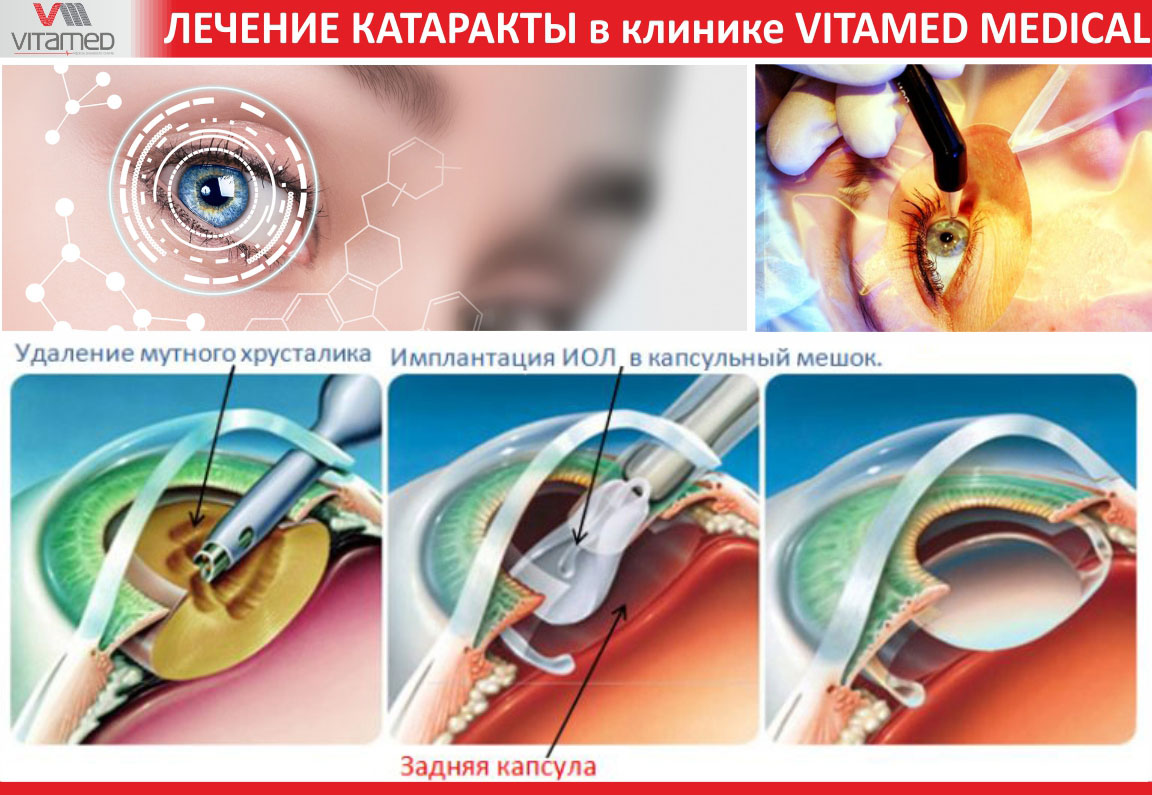
Treatment of cataracts at the VITAMED MEDICAL clinic
Let's talk about what cataracts are, the causes of their occurrence and how they are treated with the specialist ophthalmologist at the VITAMED MEDICAL clinic, Abdulkhakimova Rano Alisherovna.
Cataract is an eye disease, the characteristic symptom of which is clouding of the lens, accompanied by loss of visual acuity. The lens is located behind the human pupil. The pupil, working like a camera lens, transmits rays of light. The lens of the eye refracts and focuses them on the retina by changing the curvature of its surface. This way we get a clear image. When the substance that makes up the lens begins to lose its transparency, an obstacle appears in the path of light rays and visual acuity decreases, up to its complete loss. This is a cataract.
Cataracts develop gradually, causing the eye to lose the ability to see.
The main symptoms of cataracts at the initial stage are the appearance of fog before the eyes and a gradual decrease in vision.
The only way to treat cataracts is to remove the lens and replace it with an intraocular lens.
Treatment of cataracts at the VITAMED MEDICAL clinic is carried out using phacoemulsification with implantation of an IOL (intraocular lens)
Causes of cataracts:
- Diabetes mellitus;
- Age of the person;
- Eye injuries;
- Taking drugs belonging to the group of corticosteroids;
- Smoking and prolonged drinking of alcohol;
- Eye diseases - high myopia, retinal detachment, uveitis, glaucoma, eye burns.
- Anemia;
- Skin diseases (eczema, neurodermatitis, scleroderma);
- Poisoning of the body;
- Bad environment;
- Prolonged exposure to sunlight on the eyeball.
Methods for examining patients with cataracts:
- Visiometry - determination of visual acuity;
- Tonometry - measurement of intraocular pressure;
- Biomicroscopy - examination of the anterior segment of the eyes;
- Ophthalmoscopy – examination of the fundus of the eye;
- Additional research methods;
- Refractometry;
- Determination of the anterior-posterior axis of the eyeball + calculation of the IOL;
- Ultrasound;
- OCT optical coherence tomography of the retina and optic nerve.
Tests required for cataract surgery
- General clinical blood test,
- Blood sugar test
- Blood test for prothrombin index,
- Blood test for RW, Hbs AG, Hcv Ag, HIV,
- General clinical urine analysis,
- ECG,
- Fluorography,
- Conclusion of medical specialists: dentist, ENT specialist and therapist.
Lens replacement surgery is performed under local anesthesia. The duration of the operation is from 7 to 20 minutes. 2 hours after the operation the patient can go home.
In the postoperative period, the patient must comply with:
1.Regimen for instilling drops as prescribed by the doctor.
2.For a week after the operation, you should not bend over, lift heavy objects, or apply makeup.
3.You can take a shower 5-7 days after surgery, but with your eyes closed.
4. Within a month, it is necessary to reduce visual stress at close range.
5. It is not recommended to visit the sauna for 2-3 months after cataract surgery.
Memo for patients
Today there is no need to wait for cataracts to mature. The earlier a cataract is detected, the easier the operation and, accordingly, the postoperative period will be, and the better the result.
You can ask any questions you are interested in by sending a request by email or by contacting us by phone:
info@vitamed.uz
(+998 71) 129-81-81
(+998 71) 129-82-82
Additional information:
www.vitamed.uz
Telegram channel - https://telegram.me/vitameduz
Ambulance – 1063, (+998 71) 129-00-03
Be healthy and take care of your loved ones!
Обратитесь к врачу
Информация в статье носит общий характер. Для точного диагноза и плана лечения нужен очный осмотр — позвоните, подберём удобное время.
📞+998 55 055 10 03 Book online →