
23.09.2019 · 👁 2,859
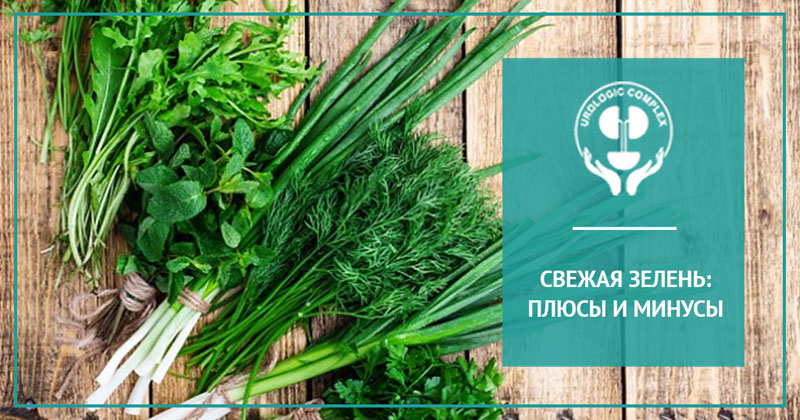
Fresh greens: pros and cons
The gardens are full of the most tender fresh herbs, and many people generously flavor almost all their dishes with it. And some even eat it with whole branches and leaves. Is this good? Are greens healthy and what is the best way to eat them?
NATURAL ANTIBIOTICS
In short, greens are very healthy. Everyone is sure that it contains a lot of vitamins. This is true, but it also has a lot of other benefits. First of all, these are the antioxidants we need so much. Plus many essential oil substances, they provide the unforgettable aromas of greenery. In addition, they have an anti-inflammatory effect.
Today it is already clear that sluggish inflammatory processes that constantly occur in our body play a very negative role. And if they are inhibited and suppressed, this will help avoid many diseases, primarily the heart and blood vessels, as well as cancer. And greens are very effective in this regard.
In addition, essential oil substances have an antibacterial effect. Because of these properties, greens are used in canning almost all foods. These substances and salt protect the products from spoilage.
But essential oil components are useful when we consume them with food. They are very good added to salads and other dishes that have not undergone heat treatment. After all, the risk that they contain bacteria is high.
Essential oil plants are also used in the treatment of colds in the form of inhalations and gargling.
Let's take a closer look at the most popular green herbs.
DILL – THE MAIN RUSSIAN GREEN
According to official statistics, most dill is eaten in Russia. And do you know how much it is consumed annually by the average citizen of our country? The figure may seem unrealistic - 1.6 kg of dill.
Of course, hardly anyone chews so many green sprigs of dill; statistics take into account its consumption throughout the country in general. And most of it is used in the food industry - dill is added to a lot of products. This is not only almost all canned food, many semi-finished products and meat products, chips and much more. And if all this is divided by the population of our country, then 1.6 kg per person will be quite realistic.
Is this good or bad? Great! There are a lot of useful things in dill. Just 10 grams of this fresh herb contains more than 10% of the daily value (DV) of vitamins A and C, in slightly smaller quantities it contains the all-important vitamin folic acid, as well as many other vitamins and minerals.
But just as important as these components in dill are antioxidants. First of all, these are monoterpenes (limonene and carvone). They block the action of a number of carcinogens, including benzopyrene. It is present in both cigarette smoke and barbecue (as well as in everything cooked on coals, barbecue and grill). It is no coincidence that dill is a mandatory accompaniment for them.
However, this is largely true of other greens. Plus, dill contains a lot of flavonoids such as kaempferol and vicetin. These powerful antioxidants prevent the development of vascular atherosclerosis and protect us from cancer and old age.
But that's not all. There is almost nothing harmful in dill. The content of calories, bad fats and carbohydrates in it is unimportant. Even oxalates (oxalic acid salts), which are abundant in other greens, are practically absent in dill. This means that it does not contribute to the formation of kidney stones at all (see “This is important”).
GREEN ONIONS ARE THE SECOND MOST POPULAR GREENS
Everyone knows about the benefits of onions. But what is more useful - green arrows or onions? Answer: Both types of onions are useful, but in different ways. One has more of some utilities, the other - others (see table).
Summer green onions contain more vitamins, minerals and dietary fiber, which are very important for digestion. The leader in content is vitamin K: 100 g of onion contains more than 2 DN. And in some cases this can have a negative effect; there are people who should not overuse green onions (see “Our Help”).
Vitamin A in onion arrows is represented by a set of carotenoids, among which beta-carotene is the most abundant. Part of it in our body is converted into vitamin A itself, the other part works as an antioxidant.
Two other carotenoids (lutein and zeaxanthin) are very important for good vision. They protect against the disease that is the leading cause of blindness, age-related macular degeneration (AMD).
But onions are also very useful. It contains many important flavonoids. And it also contains a lot of sulfur compounds, it is because of them that tears flow when an onion is cut, and because of them it smells so strongly, they also give it a harsh taste (there are more of them in the onions, but they are also present in significant quantities in the arrows). These are super-healthy substances that protect against infections (the antiviral and antibacterial effects of onions are well known), and also have an anti-cancer effect and prevent the development of atherosclerosis.
The conclusion from this information is simple: eat more green onions in the summer, and don't forget about onions in the winter.
PARSLEY IS THE MOST POPULAR GREEN IN THE WORLD
If in Russia the most eaten green vegetable is dill, then in the world in general it is parsley. It is very healthy, it also contains flavonoids and other antioxidants. Plus, myristic, limonene and eugenol have an anti-cancer effect - they give parsley its aroma. Therefore, like dill, it is perfect for fried and any dishes cooked on charcoal (they all contain carcinogens).
There are even more vitamins C and A in parsley than in dill, and vitamin K is about the same. Therefore, everything said about dill also applies to this greenery.
BASIL, IT'S NOT ONLY GREEN
This grass comes in green and burgundy. Which one is healthier? Burgundy is healthier due to the higher amount of anthocyanins. These are red-violet antioxidants. There are still a lot of them in some berries and beets. They even protect against cancer.
But green basil, like dill, also contains flavonoids. They also contain a lot of essential oil substances, as well as vitamin C. There is about 4 times less vitamin K in basil than in green onions and parsley. But this is also a decent dose.
For questions, you can contact us by phone +998 55 055 10 03, +998 55 055 10 03 and at the address Tashkent, Uchtepa district, 12th quarter, st. M. Shaikhzoda. Telegram channel: https://t.me/urologic_uz
Medical expert of this article
Рахмонов Oybek Махаммадмуйдинович
главный врач, уролог · clinic «Urologic Complex»
Appointments and consultations:
+998 55 055 10 03
Call
This information is for reference only. If you have symptoms, see a doctor.
Appointment
Обратитесь к врачу
Информация в статье носит общий характер. Для точного диагноза и плана лечения нужен очный осмотр — позвоните, подберём удобное время.
📞+998 55 055 10 03 Book online →Tashkent Medical Park
Tashkent, Учтепинский district, Chilonzor 12 block, st. М.Шайхзода, 7
Пн 08:30-20:00