
23.09.2019 · 👁 2,068
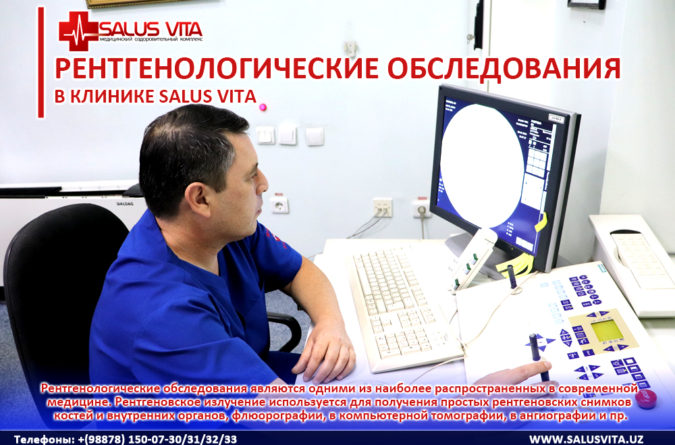
X-ray examinations at the SALUS VITA clinic
X-ray examinations are among the most common in modern medicine. X-ray radiation is used to obtain simple X-ray images of bones and internal organs, fluorography, computed tomography, angiography, etc.
Based on this, X-ray radiation belongs to the group of radiation radiation, it (in a certain dose) can have a negative effect on human health. Carrying out most modern methods of x-ray examination involves irradiating the subject with negligible doses of radiation, which are completely safe for human health.
X-ray examination methods are used much less frequently in the case of pregnant women and children, however, even in these categories of patients, if necessary, an x-ray examination can be carried out without a significant risk to the development of pregnancy or the health of the child.
In our clinic we provide the following types of x-ray examination:
Femur
Hysterosalpingography with 20 ml non-ionic contrast with instruments
Ankle joint
Knee joint
Nose bones
Shin bones
Hand bones
Bones of the forearm
Foot bones
Pelvic bones
Pelvic bones (children)
Elbow joint
Wrist joint
O/s of the thoracic spine
O/s of the cervical spine
General X-ray of the abdominal cavity
Fluoroscopy of the gastrointestinal tract
Shoulder joint
Humerus
Lumbar spine
Chest X-ray
Chest X-ray (children)
X-ray of the soft tissues of the neck according to Zemtsov
X-ray of the skull
Mastoid process according to Schuller, Shumsky, Stenvers, Mayer each:
Hip joint
Extretory urography with contrast
Irrigoscopy for children without anesthesia
Irrigography for adults
Irrigography for children with anesthesia
X-ray of the collarbone
X-ray of the sacrococcygeal.compartment.posture
X-ray
Print on digital film
PPN
Cystogram for children with 1 contrast
Functional tests of the spine
Irrigography for children without anesthesia
Adult cystogram
Ductography with contrast
Chest X-ray on analog film
Children's cystogram without contrast
Medical expert of this article
Турсунова Назокат Омилхоновна
врач гинеколог, репродуктолог · clinic «Saba Darmon»
Appointments and consultations:
+998 71 210-30-30
Call
This information is for reference only. If you have symptoms, see a doctor.
Appointment
Обратитесь к врачу
Информация в статье носит общий характер. Для точного диагноза и плана лечения нужен очный осмотр — позвоните, подберём удобное время.
📞+998 55 055 10 03 Book online →Tashkent Medical Park
Tashkent, Учтепинский district, Chilonzor 12 block, st. М.Шайхзода, 7
Пн 08:30-20:00
Также принимают