
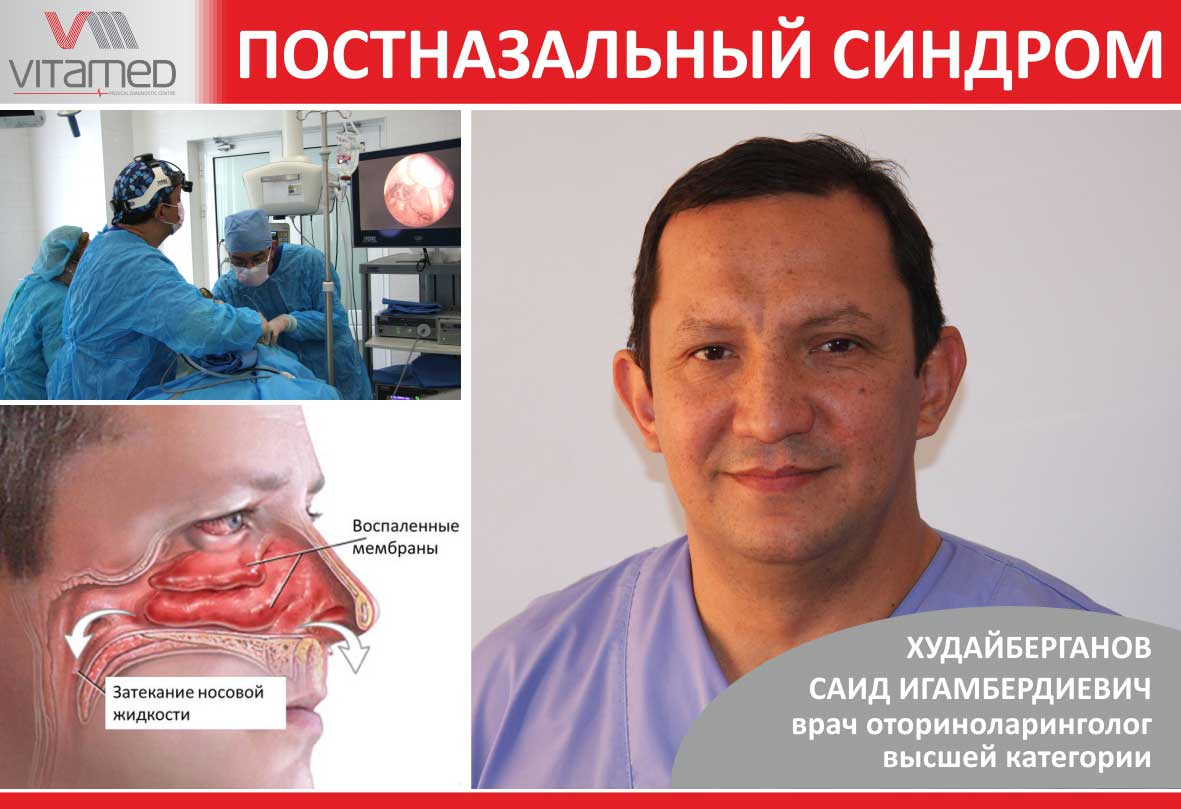
Postnasal drip syndrome
Otorhinolaryngologist of the highest category at the VITAMED MEDICAL clinic, Said Igamberdievich Khudayberganov, will introduce you to an article on the topic: “Postnasal drip syndrome”
“Very often, practicing doctors - pediatricians, therapists and ENT doctors hear from patients such complaints as a feeling of discomfort, soreness and a lump in the throat, frequent coughing, drainage from the nasopharynx, low-grade fever without any particular signs of illness. These symptoms are observed collectively
with drip syndrome or postnasal drip, which I would like to describe in more detail in this article.
The term “Postnasal drip syndrome or postnasal drip syndrome” (eng. postnasal drip) refers to a combination of clinical symptoms characterized by an inflammatory process, as well as a violation of the normal anatomical and physiological structure of the upper respiratory tract (nasopharynx, nasal cavity, paranasal sinus system), in which mucopurulent discharge from the nasal cavity flows down the back wall of the pharynx and larynx, where it occurs mechanical stimulation of the afferent part of the cough reflex arc, which causes the appearance of symptoms of postnasal drip.
Etiopathogenetic causes of postnasal drip
The disease occurs everywhere, regardless of socio-economic indicators and climatic characteristics of the region of residence. In more than 35% of cases, the syndrome is caused by acute and chronic rhinitis, and in another 20-25% - by various forms of sinusitis. Concomitant malformations of the nasopharynx and nose are present in 15-25% of patients. Complications in the form of inflammatory lesions of the larynx and tracheobronchial tree are detected relatively often - in 20% of patients.
Postnasal drip is the result of diseases of the ENT organs, in which there is an increase in the permeability of blood vessels and exudation of a mucopurulent nature, and the functioning of regional exocrine glands that produce mucus is disrupted. The function of this system is mucociliary clearance, i.e. moisturizing and cleaning the nasal cavity, nasopharynx, paranasal sinuses from inhaled substances.
Dysfunction of these glands and excessive mucus production can be caused by the following factors:
- Diseases of an infectious or allergic nature. Most often these are allergic, bacterial, fungal or viral sinusitis, vasomotor, medicinal or post-infectious rhinitis, rhinitis of pregnant women. In children, this pathological condition causes the proliferation of adenoid vegetations and their inflammation - adenoiditis.
- Congenital and acquired anomalies of the upper respiratory tract. In this case, it is a cyst-like bursa of Thornwald. Contributing factors may include deformation of the nasal septum, bullous transformation of conchae, postoperative synechiae and adhesions of the mucous membrane.
- Diseases of the gastrointestinal tract. Rare causes include pathologies of the digestive system, accompanied by the reflux of stomach contents into the lumen of the oropharynx, esophageal diverticula, diaphragmatic hernia and laryngopharyngeal reflux.
Predisposing factors for postnasal drip include smoking, unfavorable environmental conditions, working with chemicals or in dry air conditions, hormonal imbalances of various origins, prolonged or uncontrolled use of certain medications and vasoconstrictor nasal drops.
Clinical picture
The clinical picture is dominated by nonspecific symptoms characteristic of an acute respiratory viral infection.
Manifestations of the syndrome are:
- a feeling of accumulation of mucus in the posterior sections of the nasal cavity, flowing down the back wall of the pharynx, symptoms intensify in the morning: patients wake up with discomfort in the throat and describe their condition as a “lump” in the throat, but upon examination of the pharynx there are no signs of inflammation;
- coughing, especially at night and in the morning, but auscultation of the lungs does not reveal any pathological changes;
- frequent discharge of mucous clots, which are sometimes orange-brown in color. When examining the pharynx, you can see mucous strands stretching from the nasopharynx behind the soft palate.
Very often, during an outpatient endoscopic examination, characteristic findings of postnasal drip are stagnant accumulations of mucus in the posterior parts of the nasal cavity (usually at the bottom, under the posterior ends of the inferior turbinates), or streams of thick secretions that are transported from the nasal cavity or from the anastomosis of the paranasal sinuses into the pharynx, bypassing the posterior surface of the soft palate or the pharyngeal openings of the auditory tubes. In this case, they speak of endoscopically positive postnasal drip syndrome. In the absence of pathological accumulations of mucus, the syndrome is defined as endoscopic negative postnasal drip syndrome. In some cases, cough may be the only symptom. On auscultation, as a rule, vesicular breathing is heard; wheezing is not heard. The cough is dry in nature, but due to the coughing up of nasal mucus that has flowed into the respiratory tract, according to patients' complaints, it is characterized as productive.
Sometimes, with leakage syndrome, symptoms of pharyngitis may be observed (the back wall has a characteristic appearance in the form of “pomegranate seeds” - a sign of granulosa pharyngitis), which are associated with the flow of pathological secretions from the nasal cavity or paranasal sinuses along the back wall of the pharynx; pharyngitis can also be caused by breathing through the mouth and abuse of vasoconstrictor drops (decongestants), which flow from the nasal cavity into the pharynx and have an anemic effect on the pharyngeal mucosa. Some patients, mainly children, note coughing up a large amount of mucus in the morning, due to its accumulation in the pyriform sinuses; in this case, the cough sometimes leads the patient to vomiting.
Diagnostics
The diagnosis of “postnasal drip” should be based on medical history, characteristic complaints (a feeling of secretions flowing down the back of the throat), laboratory tests, computed tomography results, and always on the results of an endoscopic examination. Doctors often mistake this condition for chronic bronchitis. And in order to correctly diagnose and prescribe treatment, a thorough examination of the ENT organs is necessary. It should be clarified that the clinical manifestations of postnasal drip are not specific - the connection between chronic cough and upper respiratory tract pathology is not always clearly visible and therefore requires additional confirmation.
Treatment
Treatment consists of eliminating the primary source of inflammation using medication or surgery.
The key to relieving the manifestations of postnasal drip is treatment of the underlying disease. The main method of drug treatment for postnasal drip in patients with allergic rhinitis is the use of intranasal topical corticosteroids.
In children, complete cessation of the symptoms of postnasal drip can be achieved after treatment of signs of chronic inflammation of the nasopharyngeal tonsil (chronic adenoiditis), as well as after surgery - endoscopic removal of adenoid hyperplasia using a diode laser.
For diseases of the nasal cavity, paranasal sinuses and nasopharynx, accompanied by postnasal drip, various treatment methods are used: from courses of antibiotic therapy to endoscopic operations on the intranasal structures and paranasal sinuses (for chronic sinusitis) - FESS.
In some cases, good results are obtained from operations on the posterior ends of the inferior turbinates - shaver resection, bipolar coagulation or laser disintegration, widely used in the VITAMED MEDICAL clinic.
Correction of a deviated nasal septum and resection of bullous middle turbinates help restore the normal anatomy of the nasal cavity, normalize aerodynamics, and often make it possible to reduce the severity or completely stop the manifestations of postnasal drip. In the presence of Thornwaldt's bag, surgical methods are also used.
Complications
In the absence of timely treatment, complications of postnasal drip may appear in the form of the spread of the inflammatory process to the lower respiratory tract - these are recurrent or chronic pharyngitis and laryngotracheitis, as well as difficult to treat, bronchitis and pneumonia. Less commonly, discharge penetrates the esophagus, causing esophagitis.
Prevention of postnasal drip
Postnasal drip, as already indicated, is caused by various diseases, so their prevention will be the prevention of the syndrome.
If you have a tendency to catch colds, you need to strengthen your immune system, lead a healthy lifestyle, and treat acute respiratory infections and acute respiratory viral infections. Timely treatment will prevent the occurrence of postnasal drip.
People prone to allergies should be careful during seasonal exacerbations.
If there are surgical diseases of the nasal cavity, nasopharynx and sinus system, it is necessary to undergo timely surgical intervention to eradicate the root cause of this condition.
In order not to irritate the nasopharynx, you need to avoid perfumes, the smell of tobacco smoke, other strong odors and polluted air, ventilate and humidify the premises.
Simple but effective measures will help avoid the occurrence of postnasal drip."
You can always ask the specialists of the VITAMED MEDICAL clinic any questions you are interested in by sending a request by e-mail or by contacting us by phone:
info@vitamed.uz
(+998 71) 129-81-81
(+998 71) 129-82-82
Additional information:
www.vitamed.uz
Telegram channel - https://telegram.me/vitameduz
Ambulance – 1063, (+998 71) 129-00-03
Be healthy and take care of your loved ones!
Обратитесь к врачу
Информация в статье носит общий характер. Для точного диагноза и плана лечения нужен очный осмотр — позвоните, подберём удобное время.
📞+998 55 055 10 03 Book online →