
02.06.2018 · 👁 44,133
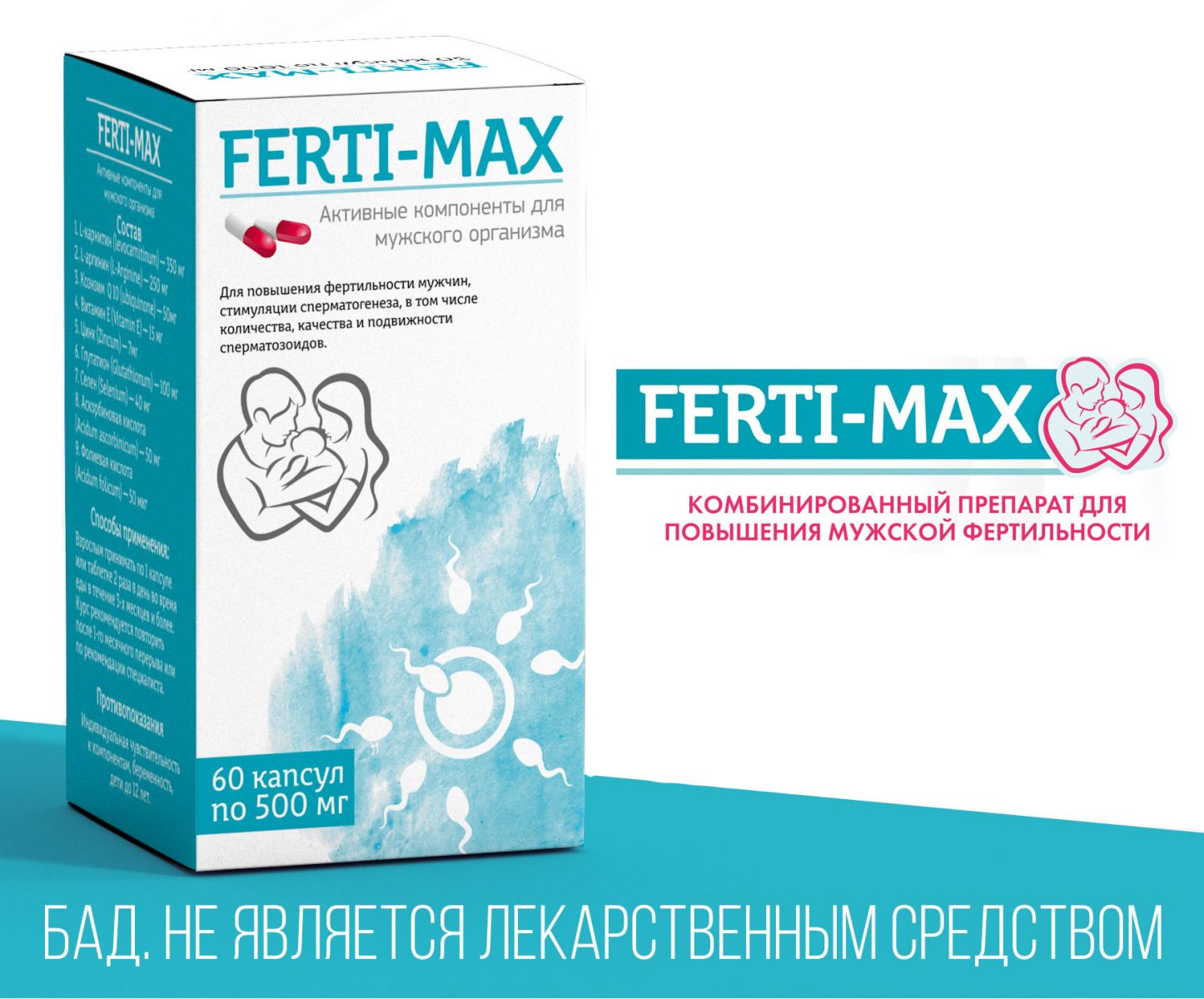
"FERTIMAX" - COMBINED DRUG TO INCREASE MALE FERTILITY
A man's reproductive abilities depend, first of all, on the quality, quantity and mobility of male reproductive cells - sperm. Only fully mature sperm are able to carry a set of his genes, fertilize a woman's egg and give life to a healthy child. The formation of new sperm and their maturation takes 72-75 days. Therefore, the course of treatment lasts at least three months.
The composition of the drug is unique:
L-carnitine (levocarnitine) - L-carnitine (also known as levocarnitine, Vit. BT or Vit. B 11) is an amino acid similar in structure to B vitamins. It participates in the metabolism of fatty acids in the Krebs cycle, thereby providing the body with energy, which is particularly used for maturation, sperm movement and the process of spermatogenesis. According to clinical studies, L-carnitine significantly increases sperm motility, sperm concentration, sperm count and the likelihood of conception. Additionally, it protects sperm from oxidative damage by removing excess cellular acetyl-CoA, providing primary antioxidant protection.
L-arginine is an amino acid from which nitric oxide is synthesized. This is the main component for the formation of sex hormones. It increases the amount of sperm in the body, improves its quality and sperm motility. like other amino acids, it is a building material from which the body synthesizes proteins, hormones, and enzymes. Getting on the genital mucosa, menthol enhances the absorption of L-arginine, which, having a local effect, promotes the healing and restoration of its cells. Further, being absorbed and entering the circulatory system, an enzyme (nitrogen monoxide synthetase) is synthesized from L-arginine and nitrogen monoxide (N0) is formed intracellularly - an unstable compound that exists in the body for about 2 hours. During the presence of NO, the smooth muscles of the walls of all blood vessels relax in the body, which contributes to a significant improvement in blood circulation and lymph circulation in the human body. In addition, nitrogen monoxide controls both intracellular and intercellular processes, i.e. it participates in and accelerates the transmission of nerve impulses from one nerve ending to another much faster than natural neurotransmitters. The mechanism of action of nitrogen monoxide on the blood supply to the genital organs, and, consequently, on the strength of erection and orgasm, occurs the same in both women and men.
Coenzyme Q 10 - The daily requirement for coenzyme Q10 is 60-100 mg. About 50% of coenzyme Q10 is synthesized in the body, and some comes from food, mainly through the consumption of meat, fatty fish, palm and soybean oil, and peanuts. Addition of coenzyme Q10 to the ejaculate significantly increases sperm motility and their fertilizing ability in vitro. Taking coenzyme Q10 in a daily dose of 200 mg for 3 months is accompanied by an improvement in the basic spermogram indicators, increasing the antioxidant capacity of spermoplasm and normalizing pro- and antioxidant processes (Galimova E.F., 2013). The use of ubiquinone is justified in the complex therapy of idiopathic forms of male infertility. It is worth considering that the synthesis of ubiquinone will not occur without the participation of such important components as folic and pantothenic acid, vitamins B1, B2, B6 and C. In the absence of one of these elements, the production of coenzyme 10 is reduced.
Vitamin E is rightly called tocopherol, which translated means “to bear offspring.” Active tocopherol compounds have an antioxidant effect, which destroys free radicals in the human body. This property of vitamin E helps protect sperm from damage by preserving the integrity of the cell structure. By neutralizing free radicals, vitamin E in male infertility restores the integrity of sperm DNA, which helps cure infertility. With a lack of tocopherol in the body, oxygen starvation occurs, which leads to sperm defects, but such a pathology can be eliminated in a short period of time by normalizing the amount of this substance.
Properties of tocopherol:
• Protection of germ cells from oxidation;
• Normalization of testosterone levels;
• Increased fertilization ability.
Here is the formula of Tocopherol
Zinc – Zinc occupies a special place in the list of microelements essential for men's health. With its deficiency, already at a young age, boys experience delayed sexual development, and men experience infertility. The need for zinc in men is only 15–20 mg per day; most of the population of the stronger half of humanity is deficient in this microelement. The fact is that modern food products are sorely lacking in zinc, so where does it come from in the body? Zinc deficiency has a particularly negative impact on men's health: the production of the male sex hormone testosterone decreases, potency and testicular function decrease, and the amount of sperm decreases, which leads to the inability to conceive a child. Another difficulty is that during active sexual life, some zinc is additionally lost along with sperm.
Glutathione is a tripeptide with a specific function, widely distributed in cells. Glutathione contains glycine, cysteine and glutamic acid. The strongest hepatoprotector, antioxidant, immunostimulant and detoxifier. Glutathione is found in large quantities in the liver, erythrocytes and adrenal glands. The reduced form of glutathione activates some enzymes. Glutathione binds to heavy metal ions that act on sulfhydryl and disulfide groups of proteins, neutralizes them. Glutathione is involved in metabolism as a hydrogen carrier. It has antioxidant properties. Glutathione is necessary for carbon metabolism, protects the pancreas from oxidative damage, has an effect on lipid metabolism, prevents the formation of atherosclerosis, and slows down the aging process. In case of male infertility, during the formation of spermatozoa, glutathionic acid, from spermatogenesis cells, helps in the “ripening” of spermatids to full-fledged spermatozoa.
Selenium - The adult human body contains about 15 mg of selenium. Its maximum concentration is found in the testicle, epididymis, liver, thyroid gland, and heart. The daily intake of selenium is about 70-100 mcg per day. The most selenium is found in seafood, liver, kidneys, meat, cereals, eggs, garlic, broccoli, and brewer's yeast. Selenium has proven to be most effective in the treatment of idiopathic forms of male infertility in combination with vitamin E. Administration of selenium at a dosage of 200 mcg for 100 days (Moslemi M.K. et al., 2011) leads to an increase in morphologically normal forms and increased progressive sperm motility, as well as an increase in the frequency of spontaneous pregnancies.
Vitamin C (ascorbic acid) C6H8O6 – in addition to having antioxidant properties, it restores serotonin, which affects the processes of inhibition and excitation in the reproductive system. The female body also needs this vitamin, since serotonin ensures the normal course of the ovulation process, preparation for childbirth and its coordination. In addition, L-ascorbic acid is of great importance in increasing libido and restoring vitamin E, which ensures reproduction. The daily requirement for ascorbic acid is 70-250 mcg.
Medical expert of this article
Джураев Хасан Каримович
врач уролог-андролог · clinic «Doctor Hasan»
Appointments and consultations:
+998 55 055 10 04
Call
This information is for reference only. If you have symptoms, see a doctor.
Appointment
Обратитесь к врачу
Информация в статье носит общий характер. Для точного диагноза и плана лечения нужен очный осмотр — позвоните, подберём удобное время.
📞+998 55 055 10 03 Book online →Tashkent Medical Park
Tashkent, Учтепинский district, Chilonzor 12 block, st. М.Шайхзода, 7
Пн 08:30-20:00
Также принимают